

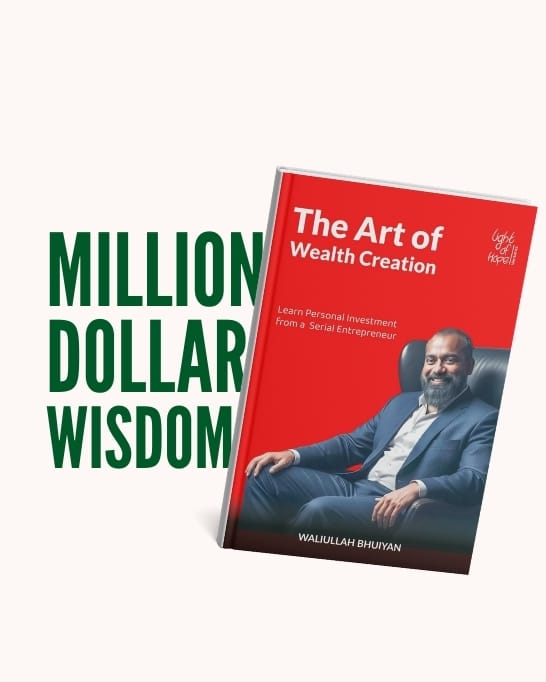
The Art of Wealth Creation — Complete Book Analysis
By Waliullah Bhuiyan | Published by Light of Hope Ventures
1. Simple Introduction
Most people in Bangladesh work hard their entire lives — yet never achieve true financial freedom. They save in banks, buy land, or trust friends with their money. And most of the time, they end up frustrated, broke, or both.
The Art of Wealth Creation is a no-nonsense, experience-backed guide written to fix exactly that. Written by serial entrepreneur and investor Waliullah Bhuiyan, this book teaches you how to think like an investor, evaluate businesses with logic instead of emotion, build a smart portfolio, and eventually reach financial independence — all within the specific context of Bangladesh’s economy.
What makes this book stand out is that it is not just theory. The author shares his own real investment decisions — the brands he invested in, why he chose them, what he looked for, and what he learned. It is part textbook, part personal journal, and fully practical.
2. Author Overview
Waliullah Bhuiyan is a Bangladeshi serial entrepreneur, investor, mentor, and the Founder & Chairman of Light of Hope (LoH) Ventures. Over the past decade, he has built two private limited companies from the ground up, creating several well-known brands in Bangladesh.
Key Highlights of His Background:
- National SME Award Winner 2023 — recognized as Best Entrepreneur
- Ex-Manager at BRAC — one of Bangladesh’s largest development organizations
- Founding Director of ToguMogu — a popular parenting platform with 300K+ users
- Co-Founder of Kids Time — an education platform with 5,000+ graduates across 5 countries
- Creator of Goofi — a children’s toy brand selling in 90 countries with 100+ products
- Creator of Pathshala — reaching 700 libraries and 300K+ children
- Educator at Cambridge, Europa-Universität Flensburg, IUT, and Mirzapur Cadet College
- Mentor to 300+ founders through Light of Hope Ventures in the last few years
He has studied investment theses from global legends like Warren Buffett, Peter Lynch, Charlie Munger, Benjamin Graham, and Cathie Wood — and applied those learnings to Bangladesh’s small and medium enterprise (SME) market.
3. Seven to Ten Key Ideas
Idea 1: The Power of Leverage
Wealth is not built only through hard work — it is built through smart work and leverage. There are two types of leverage: things you own yourself (knowledge, network, position) and things that belong to others (other people’s time and capital). The rich get richer because they leverage both skillfully.
Idea 2: True Independence Goes Beyond Financial Freedom
The author introduces a deeper concept of freedom with four layers:
- Freedom of Thought — thinking without bias
- Freedom of Relationship — choosing who you spend time with
- Freedom of Time — controlling how your hours are used
- Financial Freedom — when your investments cover your lifestyle
Most people only aim for financial freedom while ignoring the other three — which makes even financial freedom harder to achieve.
Idea 3: Emotional Investing Is the Root of Financial Loss
People across Bangladesh — educated, smart, and capable — lose money not because they lack intelligence, but because they make investment decisions based on emotion, not evidence. Trust in a person is not a valid reason to invest in their business. The merit of the business is what matters.
Idea 4: The Rule of 72 and the Magic of Compounding
If you invest 10 lakh taka at 18% annual return, your money doubles every 4 years. In 20 years, that same 10 lakh becomes 3.2 crore taka — without touching it. This is the magic of compounding, and it is the core wealth-building tool used by the world’s greatest investors.
Idea 5: The 5M Framework for Business Evaluation
Before putting money into any business, evaluate it using five criteria: Market (is there real demand?), Model (how does it make money?), Moat (what is the competitive advantage?), Management (who is leading it?), and Money (is cash flow healthy?). If any of these is weak, reconsider.
Idea 6: Founders Matter More Than Ideas
A great founder can rescue a bad idea. A bad founder can destroy a great one. When investing in a business, you are fundamentally betting on the person running it. Look for clarity of purpose, execution history, adaptability, integrity, and team leadership ability.
Idea 7: Playing It Too Safe Is the Riskiest Strategy
Keeping money in a fixed deposit at 10% interest, when inflation is around 12%, means you are quietly losing purchasing power. SMEs and startups — when chosen wisely — can generate 15–25%+ annual returns, far outperforming FDRs and land in the long run.
Idea 8: Diversification Is Financial Freedom
Never put all your money in one place. A smart portfolio balances emergency savings, real estate, SME investments, stocks or mutual funds, and investment in your own learning and network.
Idea 9: Your Job Should Not Be Your Only Income
Financial independence requires multiple income streams. Use your skills, experience, and network to generate passive income through courses, consulting, book royalties, equity in startups, and smart investments — not just your monthly salary.
Idea 10: Red Flags Are Real — Learn to Spot Them
If someone promises 30–40% returns consistently, be suspicious. If a founder cannot explain numbers, has no written financials, depends on one customer, or avoids hard questions — walk away. Being too greedy is what causes ordinary people to lose their life savings.
4. Chapter-Wise Short Summary
Chapter 0 — Million Dollar Wisdom
This chapter is a mindset reset before the actual content begins. Waliullah introduces three foundational concepts: the Power of Leverage (using your knowledge, network, position, others’ time, and others’ capital), True Independence (the four-layered freedom of thought, relationship, time, and finance), and Readiness for Financial Freedom (the mental and practical preparation needed before you invest a single taka). He shares his own personal journey as a middle-class Bangladeshi who built wealth step by step — first through knowledge, then people, then network and capital.
Chapter 1 — The New Age of Investing
Bangladesh is changing. The economy has crossed $480 billion. SMEs make up 30% of GDP and employ 87% of the workforce. The startup ecosystem has crossed $1 billion in total funding — mostly from foreign investors. Local investors are missing out. This chapter introduces a new investor mindset: analytical over emotional, disciplined over reactive, impact-driven over speculative. It contrasts the old investor mindset (trust-based, short-term, land-focused) with the new one (merit-based, long-term, diversified).
Chapter 2 — The Investment Reality in Bangladesh
Most Bangladeshi personal wealth sits in land (60%), savings/FDR (25%), and stocks (10%) — with only 5% in SMEs and startups. This chapter uses the Rule of 72 to show the power of compounding, demonstrates how 10 lakh taka invested at 18% becomes 3.2 crore in 20 years, and introduces a balanced portfolio model that allocates 20% to emergency savings, 30% to real estate, 30% to SMEs/startups, 10% to stocks/mutual funds, and 10% to learning and networking.
Chapter 3 — The Mindset of Great Investors
Before learning where to invest, you must master how to think. This chapter draws from the philosophies of Warren Buffett, Charlie Munger, Peter Lynch, and Benjamin Graham. Key principles include: think long-term, stay within your circle of competence, focus on value (not price), use a margin of safety, and remain emotionally neutral. Fear and greed are the twin destroyers of wealth.
Chapter 4 — How to Assess a Business Quickly
Introduces the 5M Framework: Market, Model, Moat, Management, and Money. Includes a worked example evaluating a local café. Also presents red flags to avoid — founders who can’t explain numbers, no written financials, over-dependence on one client, promises that are too good to be true. The author shares his first real investment (TYLO — a men’s plus-size fashion brand) and walks through all seven criteria he used before investing.
Chapter 5 — How to Assess a Founder
The Founder Fit Framework evaluates five dimensions: Clarity of Purpose, Execution Record, Adaptability, Integrity, and Team Leadership. Using a case study of a local clothing brand founder named Runa — who scaled from 3 to 30 employees through discipline — the chapter shows that management quality determines success more than funding. The author also shares his second investment (Chardike — a beauty and makeup brand) and third investment (One Ummah BD — an Islamic lifestyle brand), explaining the specific founder qualities that attracted him.
Chapter 6 — Designing Your Investment Strategy
A four-step process for building your personal investment plan: (1) Define your goals, (2) Know your risk profile (conservative, balanced, or aggressive), (3) Build your portfolio across savings, real estate, SMEs, startups, and learning, (4) Set personal investing rules — a personal “constitution” that protects you from emotional decisions. The author shares his fifth investment (EducationAid — a wooden toy manufacturer) and explains why he invested in a direct competitor of his own brand Goofi.
Chapter 7 — Avoiding Common Investment Mistakes
The top five mistakes: investing on trust instead of merit, skipping due diligence, going all-in on a single opportunity, having no exit plan, and following hype instead of fundamentals. Uses a case study of a Dhaka-based social media startup that raised money promising 5x growth — and collapsed within 12 months, wiping out 100% of investor capital. Provides a pre-investment checklist to protect your money.
Chapter 8 — Principles for Financial Independence
The wealth equation: Wealth = (Earning – Spending) × Investing × Time. The chapter shows that someone who starts investing at 25 reaches 3.8 crore by age 50, while someone who starts at 45 reaches only 28 lakh. The five-step Financial Independence Framework: create surplus, invest intelligently, reinvest for compounding, build passive income, and reach freedom when investments cover your lifestyle. The author shares his fourth investment (Green Grocery — a food supply business for local restaurants) and explains the hidden goldmine of a niche customer segment.
Chapter 9 — Investment Case Studies (Bangladesh Examples)
Three illustrative case studies: (1) A bakery SME using a profit-sharing model that generated 18% annual ROI plus equity gain, (2) A logistics tech startup that returned 8x to an early investor in 5 years, and (3) A women-led green fashion social enterprise with 10–12% ROI but 50+ jobs created. The author also shares his sixth investment (WeGro’s onion harvest project) — explaining why he chose agro-investment over gold, including the platform’s insurance coverage for principal protection.
Chapter 10 — The Investor’s Toolkit
Practical tools you can use today: a Business Evaluation Sheet (scoring Market, Model, Moat, Management, and Money from 1–5), a Founder Evaluation Sheet (scoring Clarity, Execution, Adaptability, Integrity, and Leadership), a Personal Investment Plan Template, and a Red Flag Checklist. The author shares his seventh investment (iFarmer’s spray machine project) — a low-entry, long-term, agro-machinery investment with 60% return over 3 years and trusted platform backing.
Chapter 11 — From Fear to Freedom
Business investment is one path to financial freedom — not the only path. You can also use your skills, experience, and network to earn passive income. The author shares his own passive income strategy: training and course income, investment profit-sharing, equity in new startups, book royalties, and consulting. His eighth investment (Meraki — a women’s shoe brand) is shared here, with a detailed analysis of brand positioning and female consumer behavior. The chapter closes with seven actionable steps for anyone to begin building financial independence within five years.
5. Key Lessons
Lesson 1 — Never invest based on trust alone. The merit of the business must be your reason — not the personality of the person asking for your money.
Lesson 2 — Start early. Compounding works like a snowball. The longer it rolls, the bigger it gets. Every year you delay is compounding working against you.
Lesson 3 — Diversify intelligently. Spreading money across asset classes, sectors, and time horizons reduces risk without sacrificing returns.
Lesson 4 — Know your circle of competence. Only invest in sectors you understand, or where you have people who understand it for you. If you can’t explain the business in one sentence, don’t invest.
Lesson 5 — The founder is the business. A mediocre business with a great founder can thrive. A great idea with a bad founder will fail.
Lesson 6 — Boring businesses are often the best investments. Fashion, food, agro, basic goods — these sectors always have demand. Fancy, trendy businesses with no fundamentals collapse fast.
Lesson 7 — Be skeptical of very high returns. Anything promising more than 25–30% annual returns consistently should raise alarm bells. Greed is how millions in Bangladesh are lost every year.
Lesson 8 — Financial freedom requires mental preparation first. Before you can invest wisely, you need to fix your relationship with money, build saving habits, reduce unnecessary spending, and develop the patience to let compounding work.
Lesson 9 — Your network is your net worth. The author consistently leveraged relationships — with founders, mentors, and platforms — to find better investments and support portfolio companies beyond just providing capital.
Lesson 10 — Investing is a long game. The world’s best investors think in decades, not days. One bad year should not change your long-term strategy.
6. Actionable Takeaways
1. Calculate your savings capacity today. Before investing anything, answer this: can you save? If you can’t, either reduce lifestyle expenses or increase income. You cannot invest what you do not have.
2. Build an emergency fund first. Set aside 3–6 months of expenses in a liquid, accessible account. This protects you from making desperate decisions during a crisis.
3. Apply the Rule of 72 to every investment offer. Divide 72 by the promised annual return. That is how many years it takes to double your money. Use this to compare opportunities and spot unrealistic promises.
4. Use the 5M Framework before every investment. Score each business you consider across Market, Model, Moat, Management, and Money — on a scale of 1 to 5. Only invest when the total score meets your threshold.
5. Research the founder deeply. Before investing, spend at least one hour studying the founder. Check their LinkedIn, social media, previous ventures, and how they handle failure. Watch videos and read interviews if available.
6. Diversify your savings into the recommended portfolio model. Allocate roughly: 20% emergency savings, 30% real estate, 30% SMEs/startups, 10% stocks or mutual funds, 10% learning and networking.
7. Start building a side income stream today. Choose one skill you have — writing, teaching, coding, consulting, cooking — and find one platform or channel to monetize it. Do not wait until you have money to invest.
8. Keep an investment journal. Every time you consider or make an investment, write down exactly why. This protects you from repeating emotional mistakes and helps you learn from both wins and losses.
9. Reinvest your profits. Do not withdraw investment returns for lifestyle spending. Let them compound. Review withdrawals only after you have achieved your target passive income level.
10. Read at least one financial literacy book per quarter. The author recommends starting with The Psychology of Money by Morgan Housel. Building financial literacy is itself an investment with infinite ROI.
7. Who Should Read This Book
This book is ideal for:
- Young professionals in Bangladesh (25–40) who earn a steady income but have no investment plan and want to start building wealth intelligently.
- First-time investors who have some savings and are unsure where to put their money — beyond land, gold, or FDRs.
- Entrepreneurs and startup founders who want to understand how investors think, what they look for, and how to attract the right capital for their business.
- Middle-class Bangladeshi families who want to break the cycle of working-and-spending and start building generational wealth.
- SME business owners who want to understand how to scale using investor capital while maintaining business integrity.
- Job holders who feel trapped in a salary-dependent life and want practical strategies to generate additional income streams.
- Anyone who has lost money in a dubious investment scheme and wants to understand why — and how to invest safely next time.
This book may be less suitable for:
- Investors already operating at institutional or large-scale corporate investment levels
- Those looking for deep financial modeling, technical stock analysis, or global portfolio theory
Final Thoughts
The Art of Wealth Creation is not just another self-help finance book filled with borrowed wisdom from Wall Street. It is a grounded, honest, and deeply practical guide built for the Bangladeshi context — written by someone who has actually built companies, invested his own money, mentored hundreds of founders, and learned hard lessons along the way.
What makes it especially valuable is Waliullah Bhuiyan’s willingness to be transparent. He shares exactly which companies he invested in, exactly why, and exactly what he looked at — including his doubts and biases. That kind of intellectual honesty is rare in investment literature.
The core message is simple but powerful: you do not need to be rich to start investing — you need to start thinking like an investor. And this book gives you precisely the tools to do that.